The Beginning Comes After the End
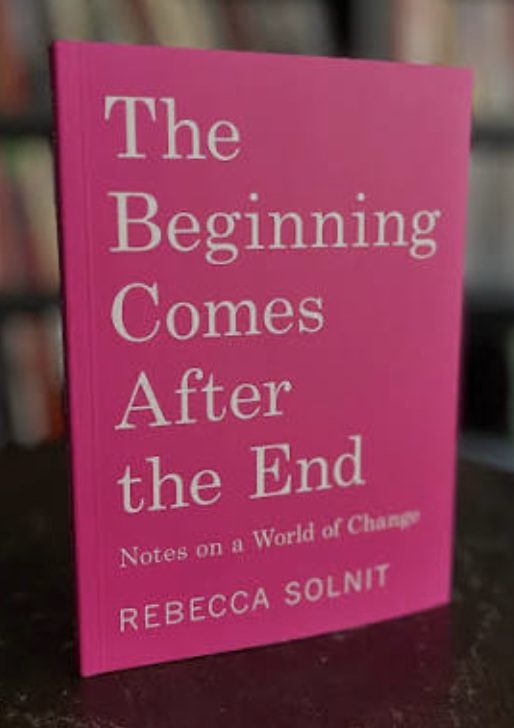
By Rebecca Solnit
In this moment when it's easy to get bogged down in hopelessness, Solnit offers us a hope that is not reaching toward a precarious, hypothetical future, but, surprisingly for some, rooted in the past.
"I have always drawn my hope from the past, not the future, from the way the past shows us how change works, how what once seemed impossible becomes actuality, from how it models the ways that power works in contradiction to what the officially powerful tell us."
Solnit opens with a reference from the Marxist philosopher Antonio Gramsci, translated by Fiamma Montezemolo: "The old world is dying. The new one is slow in appearing. In this light and shadow, monsters arise." While we have more than enough examples of monsters in the current world, some of the most frightening ones are the shadows of the monsters we project onto the future. Some of that projection is warranted in order to effect change, but it also comes with a high emotional toll.
We easily get stuck in our own timeline, meaning, generally, our own lifetime. If something is new to us, it feels new to the world, and this only heightens our fear. Solnit reminds us to turn to the past, where "many worlds have died and been born." In a time when things are exhaustingly called unprecedented, it's a comfort to be reminded that we have, in fact, been here before.
The book weaves through several themes to illustrate how the status quo we enjoy now was, not long ago, very unlikely. In true Solnit style, she moves through a vast, seemingly incongruous terrain: fascism, women's rights, honeybees, Jane Goodall, biology, Buddhism. She points to where Indigenous voices have become a reference point for modern environmental movements, and how Buddhism made its way into the mainstream. From where we currently stand, both of those shifts seem obvious, but rewinding a few decades and walking forward, we can see how hard it would have been to predict these norms not too long ago. She puts this failure of perspective more precisely than I can:
"I often have the sense that a lot of the people I read and listen to and talk with don't see the patterns, don't have a perspective that grasps the scale of change. For them, the present seems to be perpetual, unchanging, unyielding, offering confidence or despair that the future will be like the present, a conclusion that seems to be drawn from the lack of recognition that the present is a radical departure from the past."
Toward the end of the essay, she references "a new emerging subfield called processual biology that looks at the world as made up of processes rather than objects... it proposes that it is more useful to think of ourselves and most of what we call things as events." It's a bit mind-bendy to take in quickly, but the gist is a shift back toward a more Indigenous lens, one that saw the world as living and relational.
In a time when loneliness remains at the forefront of mental health concerns, it moves me deeply to imagine a future where the very concept might one day seem foreign, where we see ourselves in a constant, dynamic relationship both with ourselves and our world, where being alone is no longer even part of our cultural framework. And if that feels far off, think of IFS and how the concept of the self as a multiplicity has caught fire. The singular "I feel" shifting to "part of me feels" is subtle in syntax but massive in impact. This is the kind of change Solnit makes visible for us in retrospect. How healing it is now, to be awake to these tendrils unfurling in real time.