A World Appears
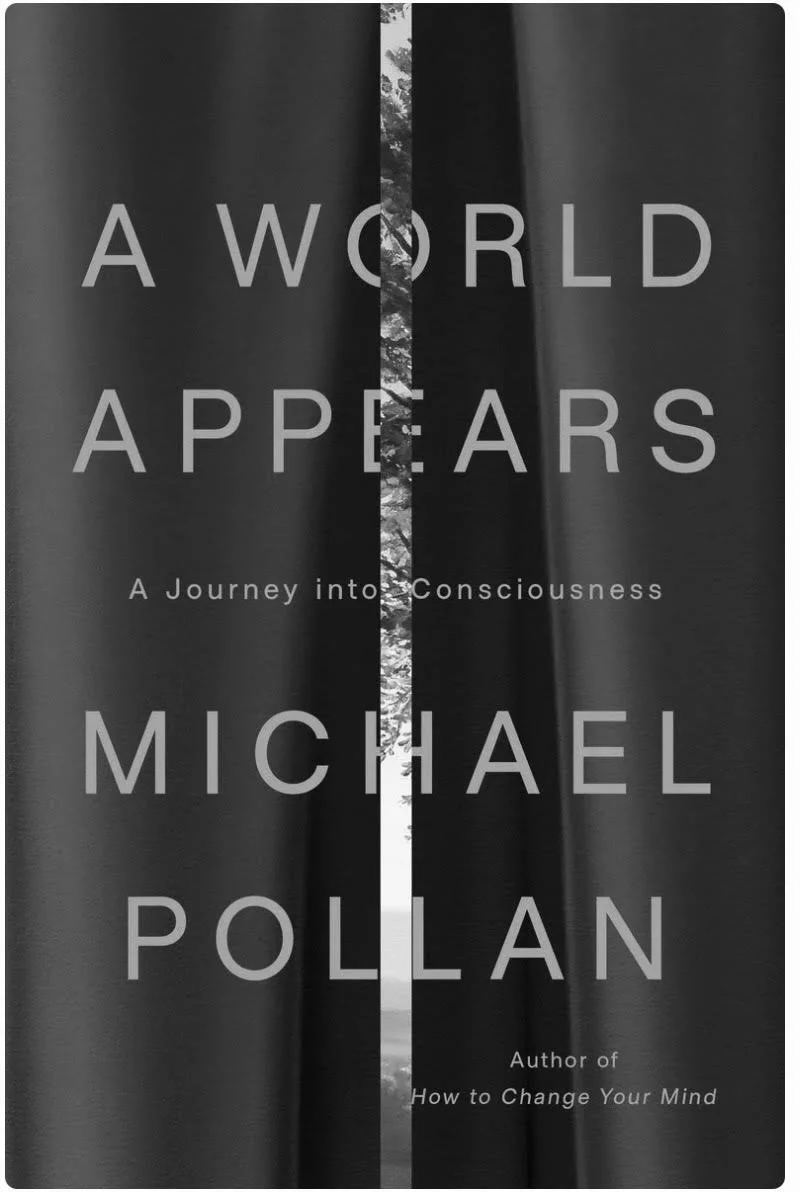
By Michael Pollan
Michael Pollan and I tend to like the same rabbit holes, and his latest book is no exception. In a moment when AI feels threatening and destabilizing for economic and existential reasons, it is perfect timing to have a complex exploration into the themes of consciousness research. It is all the more relieving to have that deep dive conclude with the author being more baffled on theme at the end than at the outset, assuaged that replicating true consciousness in the way we embody it, is a ways off.
Embody is a word I would not have used years ago when discussing consciousness. We tend to think of consciousness as an invisible constellation of ephemera (qualia being the scientific term often preferred). In college, I was trained with a neuroscience background, indoctrinated into egoic scientific materialism, locating everything of conscious human experience in the brain. But as the years have gone on, and especially as I have deepened my understanding of trauma and what does and does not constitute effective trauma treatment, I've swayed far from that initial orientation. The book mirrors this path in a number of ways, and while at times humbling, our culture needs more reminders that the self, the sense of self, the full conscious experience begins with the body rather than the top (brain)-down paradigm.
In an odd way, some surprising optimism in the book comes from following the hubristic AI research to its potential horizon lines, and in so doing, Pollan offers a bit of a balm to our existential dread. How might the very aspects we identify with our higher order humanity- complex thought and problem solving- become less ascribed to humans if AI does them better, and if that happens, what does that leave us with to define our humanness? Might that re-center the body, the felt experiences, as higher on the values list? And if that happens, how might that change the harmful paradigms modern consciousness theory has exacerbated, which have allowed us to dominate plants and animals and the natural world by distancing our sense of similarity with them? If AI can be "better" at some aspects of humanning than we are, then those aspects lose their claim to what makes us special. And thus our own hubris may be precisely what returns us to alignment with the natural world. Honestly, what a delightful twist!
That same hubris runs through the book in another direction. I smiled several times when Pollan interviewed a few feminist minded researchers who pointed out that so much of consciousness and AI based research is driven by individuals trying to transcend their humanity. In such an esoteric area of research, the qualities of the researchers play a big role in the studies being done as well as how outcomes are interpreted. In a very male dominated field, the women's voices in the text were sharp, incisive and essential, their presence reframing not just the findings but the questions being asked. This served as an illuminating spotlight on research bias in the still often male dominated research spaces and the particular risks this poses in consciousness research.
Speaking of spotlight: the differences between lantern and spotlight consciousness, coined by researcher Alison Gopnik, were well described. Reductively, lantern consciousness is what young children have as they are still developing. It allows them to take in lots of information without assumption and without narrowing their focus, as such it tends to possess a quality of awe and wonder not short-cutted through prior understanding. Spotlight consciousness is what we develop and fine tune with age, allowing us to focus on something specific. As a therapist who works with people trying to loosen exactly those kinds of calcified narratives, I found this framework resonant. It was not surprising that psychedelic experiences were referenced throughout, especially in this section, as people longing to understand consciousness would be precisely the kinds of individuals to play with the various forms available to them. At the very basest, psychedelic use often has a quality of returning the adult spotlight consciousness to the lantern consciousness of youth, truly allowing one to see with the eyes of a child and to form new ideas where prior rigid thinking has taken hold.
All of these threads converge on the same theme: that what is most essentially human may be what is least replicable, not our reasoning or our problem solving, but the felt, embodied, particular experience of being alive in a specific form. The central conclusion of the book is really arguing for the refusal to simplify, quantify, or reduce the inherent complexity of consciousness, even in research settings. To this end, Pollan so beautifully and pointedly writes:
"The informational content is more like the residue of that feeling, the lived experience of which is so much richer, marked by subjective qualities, personal associations, physical manifestations, echoes, degrees of intensity, and so on. To reduce consciousness to information (or to perception for that matter) is to do violence to its complexity."