Bird by Bird
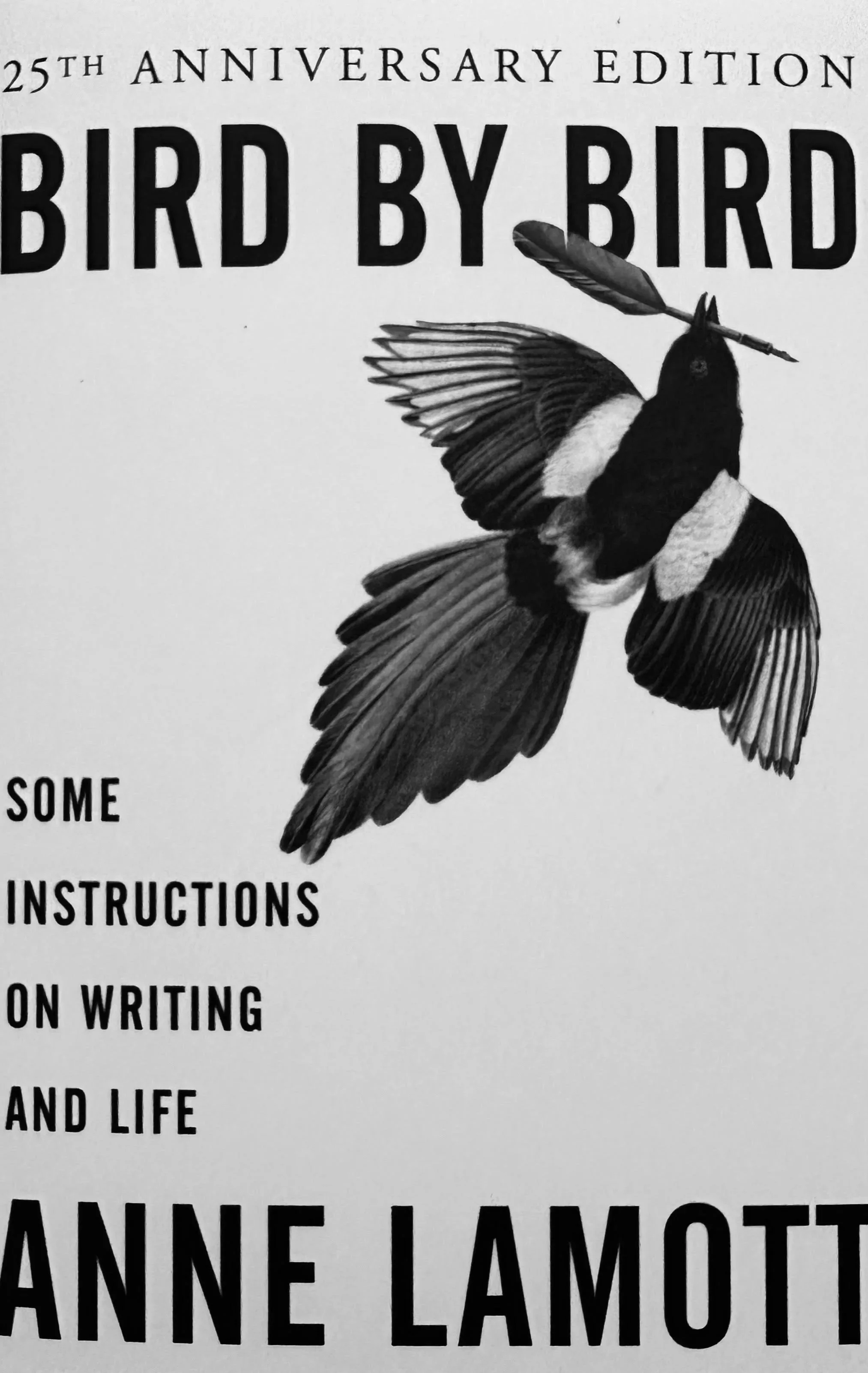
By Anne Lamott
Nothing new or flashy here, just a nod to a sentinel, Anne Lamott. Her new book co-authored with her husband, Good Writing, just came out a week or so ago. But before I get my hands on it, this one had to be touch-stoned. Anne Lamott has a sage-like way of binding the benign with the prophetic. Of course there are elements of the spiritual woven through her voice that have roots in her time spent in sobriety. But she alchemizes those often dead horses into something that has lasting resonance and welcome humor.
“You can get into a kind of Wordsmithian openness to the world, where you see in everything the essence of holiness, a sign that God is implicit in all of creation. Or maybe you are not predisposed to see the world sacramentally, to see everything as an outward and visible sign sign of inward, invisible grace. This does not mean you are worthless Philistine scum.”
I find her (like any truly good wisdom keeper) to be devotedly egalitarian with her guidance.
“Anyone who wants to can be surprised by the beauty and pain of the natural world, of the human mind and heart, and try to capture just that-the details, the nuance, what is.”
Not so thinly veiled, one of my obsessions with writing is the same as in therapy- the dogged attention to detail and nuance. That is where the good stuff happens. In therapy that pursuit is traditionally turned inwards but Lamott advocates for the artistic as well as therapeutic value in turning outwards.
“To be engrossed in something outside ourselves is a powerful antidote for the rational mind, the mind that so frequently has its head up its own ass-seeing things in such a narrow and darkly narcissistic way that it presents a colo-rectal theology, offering hope to no one.”
A grittier version of Mary Oliver’s, “attention is the beginning to devotion.” But it is true that in therapy we can run the risk of attention being so inward it ceases to serve us. The more useful work is toggling that detail-trained eye from self to world and back, not staying too long on either in order to avoid existential paralysis as much as self-absorption. Crafting our personal narrative in the larger context is essential. I believe anchoring into the universal is what gives us the stability to deep dive into the personal.
“We write to expose the unexposed. If there is one door in the castle you have been told not to go through, you must. Otherwise, you’ll just be rearranging furniture in rooms you’ve already been in. Most human beings are dedicated to keeping that one door shut. But the writer’s job is to see what’s behind it, to see the unspeakable stuff, and to turn the unspeakable into words- not just any words but if we can, into rhythm and blues.”
This post is a reflection of how I read this book, dog-eared passages and underlined sections that were just as true the first time as the 20th. I’ll leave one more here that could easily be a description of therapy as much as writing. In essence most formal therapy modalities are all different paths to the same destination. Anne suggests that map could be expanded upon to include artistic endeavors as well- she is right to loop them into the same set of instructions.
“…all of the interesting characters I have ever worked with-including myself- have had at the center a feeling of otherness, of homesickness. And it is wonderful to watch someone finally open that forbidden door that has kept him or her away. What gets exposed is not people’s baseness but their humanity. It turns out that the truth, or reality, is our home.”